
Criminal Court Cases in Glascock County
Glascock County Superior Court is the felony trial court. Its clerk keeps accusations, indictments, motions, orders, pleas, judgments, sentences, and appeals filed in those cases. Glascock County belongs to the six-county Toombs Judicial Circuit, so judges and prosecutors serve a regional circuit even though the local file remains with the Glascock County clerk. The official clerk profile identifies Kristie D. Stephens as clerk and expressly lists civil and criminal filings.
Magistrate proceedings form a different part of the Glascock County record trail. That court handles warrants, first appearances, and preliminary criminal functions. Probate Court handles misdemeanor traffic citations and game-and-fish violations within its authority. An operating municipal court, if one exists for a city matter, would keep its own file. The Georgia Courts Directory is the safe way to confirm the right court before requesting a record.
Glascock County Clerk Case Access
There is no verified Glascock County criminal docket search on the state e-access list. The dependable route is the clerk at 62 East Main Street, P.O. Box 231, Gibson, Georgia 30810. Call 706-598-2084, fax 706-598-2577, or email kristie.stephens@gsccca.org. Published hours are 8:00 a.m. to 5:00 p.m. Monday, Tuesday, Thursday, and Friday, and 8:00 a.m. to noon Wednesday. The office is the first door on the right after entering the courthouse front door.
Superior Court Clerk
62 East Main Street
Gibson, GA 30810
706-598-2084
Felony dockets, filed pleadings, dispositions, judgments, sentences, and certified court copies.
Call before travel when weather or emergency notices may affect counter access. Glascock County does not publish parking, security, or building-entry rules online.
Glascock County Case Record Searches
A useful request narrows the court, name, and time period. The clerk can then say whether a Glascock County file is at the counter, archived, or partly electronic. Ask about present search, plain-copy, and certified-copy charges before ordering because no local criminal-copy fee schedule was found.
- Decide whether the matter is a Superior Court felony or a lower-court warrant, traffic, or preliminary matter.
- Call the proper Glascock County clerk and give the name as filed, approximate year, and case number if known.
- Ask whether the docket can be inspected at the counter and whether the file is on site, archived, or electronic.
- Request the current search, copy, certification, and payment terms before staff begins paid work.
- Specify a certified final disposition when the record will support a GCIC correction or record-restriction request.
The state E-Access to Court Records directory redirects users to separate providers and requires provider accounts. Glascock Superior Court was not listed when inspected, so the directory is a finding tool, not a Glascock search form.
| Search detail | Type | Needed | Use |
|---|---|---|---|
| Name as filed | Text | Usually | Primary clerk-counter identifier |
| Case number | Text | If known | Fastest match to one file |
| Approximate year | Date range | Helpful | Narrows name searches and archives |
| Court or case type | Selection | Helpful | Routes felony, warrant, or traffic material |
| Document requested | Text | For copies | Distinguishes docket, order, or disposition |
PeachCourt and Glascock County Files
PeachCourt is a Georgia e-filing and document-access platform used by many clerks. It may require an account and may charge access or document fees. It does not replace Kristie Stephens as custodian, and its statewide reach should not be mistaken for a complete statewide criminal index. If a Glascock County name search produces nothing there, contact the clerk rather than treating silence as proof that no case exists.
The official PeachCourt image in the project manifest comes from the platform’s own site.
The image illustrates the electronic access layer, while the Glascock County clerk remains the source for a complete local file and certified copies.
What a Criminal Case File Contains
A Glascock County court file follows one prosecution. It can establish what charges were actually filed, how each count moved, and what the court ordered. It is more authoritative for the outcome than an arrest report, but it is not a statewide arrest history.
| Case number and court | Identifies the Glascock County court and one prosecution. |
|---|---|
| Charging document | Shows the accusation or indictment and the statutes charged. |
| Docket entries | Chronological filings, hearings, motions, orders, and notices. |
| Parties and counsel | Names the defendant, prosecutor, defense counsel, and judge where public. |
| Disposition and judgment | Records the result for each count, including plea, verdict, dismissal, or nolle prosequi. |
| Sentence and conditions | Lists confinement, probation, fines, restitution, and other ordered terms. |
Protected identifiers, sealed documents, and victim-sensitive facts may be omitted or redacted. No neutral Glascock County sample case was available through an official public portal, so these are request fields, not a promise that each item appears online.
Glascock County Toombs Circuit Cases
The Toombs Judicial Circuit includes Glascock, Lincoln, McDuffie, Taliaferro, Warren, and Wilkes counties. The circuit district attorney prosecutes Superior Court criminal matters, but the Glascock County clerk remains the file custodian for a Glascock prosecution. The Prosecuting Attorneys’ Council identifies the circuit district attorney’s office in Thomson at 706-595-7175.
This regional structure matters when names recur across counties. A filing in McDuffie County will not become a Glascock County case just because the same circuit prosecutor appears. Verify the county and case number on each docket. For an arrest that began locally, the related Glascock County arrest search may point to a sheriff report or Thomson booking record, but the filed prosecution belongs in the court docket.
Criminal Case Stages in Glascock County
A Glascock County arrest may lead to a first appearance, then a prosecutor decides what charge to pursue. A felony can proceed through grand-jury indictment or through an accusation where Georgia law permits it. Arraignment formally presents charges and receives a plea. Motions and discovery follow, then a plea or trial produces the disposition. Sentencing and any appeal create later entries.
Case flow: Charges Filed › Arraignment › Pretrial › Plea or Trial › Disposition › Sentencing
Booking charges can change before filing. Read the charging document and disposition by count, not only the allegation first recorded at the jail.
Glascock County Court File Terms
Georgia docket terms can signal an outcome that is easy to misread. A short glossary helps separate a filed charge from a conviction and a closed prosecution from sealed records.
- Accusation
- A prosecutor’s formal charging paper used where indictment is not required or is waived.
- No bill
- A grand jury declines to return an indictment.
- Nolle prosequi
- The prosecutor ends a charge with court approval. It is not a conviction.
- Disposition
- The controlling outcome reported for a charge.
- First Offender
- A qualifying path that may end without an adjudication of guilt after successful completion.
A dismissal, no bill, or nolle prosequi does not by itself erase the arrest cycle or seal every court page. Georgia record restriction and court sealing are separate remedies.
Glascock County Certified Case Copies
Plain copies reproduce public pages. Certified copies carry the clerk’s authentication and are often requested when a person needs to prove the final outcome or correct a missing disposition. Glascock County publishes no criminal copy or certification schedule, so ask the clerk for the current charge and accepted payment method. Do not rely on a fee quoted for another county.
The project manifest also assigns the official GSCCCA clerk listing to this court page.
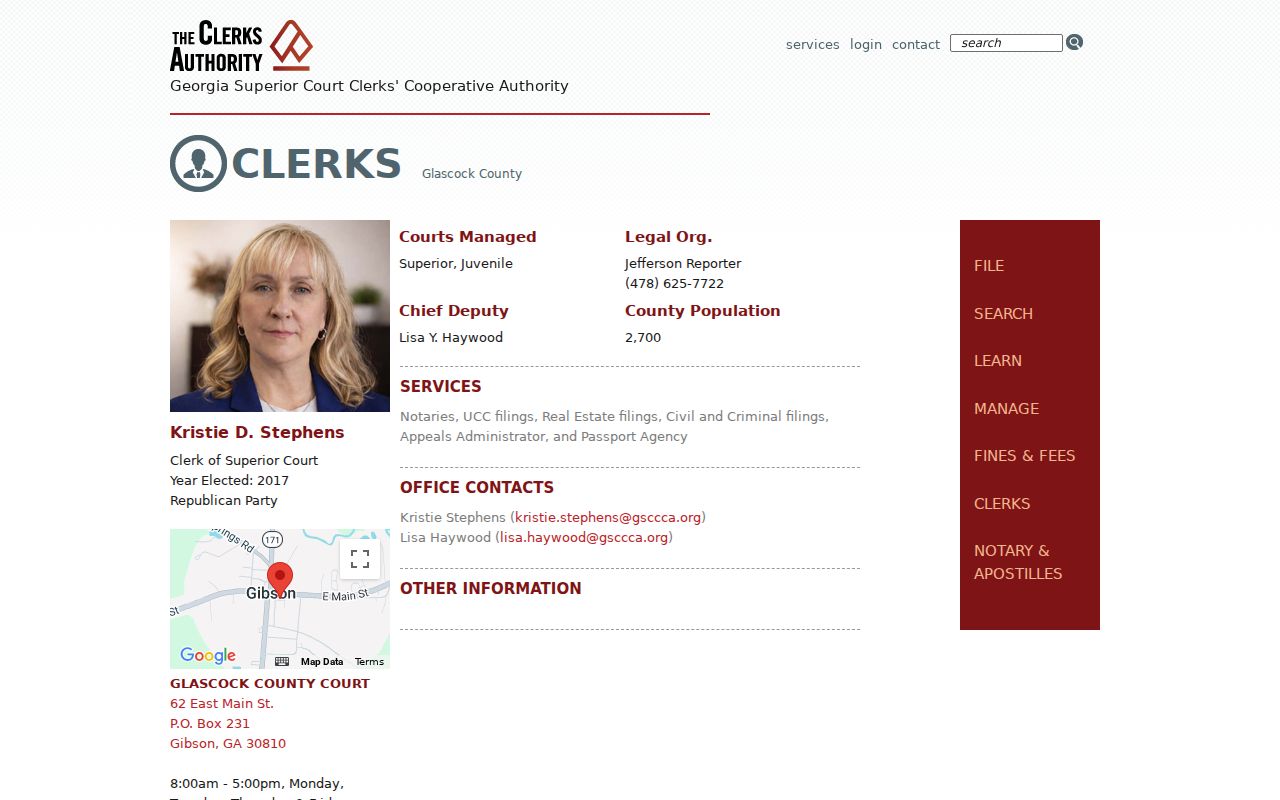
That listing supplies the verified Glascock County address, phone, hours, and criminal-filing role used for the clerk access route.
Access Rules for Case Records
Public judicial files are requested from the clerk. Georgia Uniform Superior Court Rule 21 governs access and sealing, while the Georgia Open Records Act governs many executive-agency records. A sheriff request is therefore not a substitute for a court-file request. Juvenile material, sealed records, protected identifiers, confidential victim information, and documents covered by a sealing order may remain unavailable.
Record restriction under O.C.G.A. § 35-3-37 limits eligible criminal-history dissemination. A separate court order may be needed to seal the public Glascock County court file.
If a case does not appear, ask the clerk whether it is under another spelling, in a different court, archived, or sealed. The absence of a portal result is not a legal finding. A certified disposition can also help GCIC correct a missing or incomplete arrest cycle.
Note: Confirm counter access before travel because Glascock County has posted emergency and weather-related court closure notices in recent years.